Deadlock Ranked Is Live: What It Takes to Queue in Beta Season 1
31 июля 2026
·
5 мин чтения
Deadlock's matchmaking was torn down and rebuilt on July 30, and the headline is a real Ranked Mode with seasons, a new ladder and its own rules. The entry bar is the actual story: 60 wins in Standard Mode before the queue opens at all, and every hero you want to play needs 15 wins of its own.
Standard and Ranked are now two different games
Standard Mode is the low-stakes half. No party size limit, no skill spread limit, no rank on the line, and the matchmaker adjusts the game it drops you into based on how much experience you have with the hero you picked. It is the place to learn heroes now.
Ranked Mode is the other half: seasonal, restricted, and built to put you against players at your level. Beta Season 1 started on July 30 and ends on October 7, and whatever rank you peak at is saved permanently to your rank history.
Standard Mode vs Ranked Mode
Party size
Any
→
Solo or duo
Hero pool
Every hero
→
Heroes with 15 Standard wins
Hero bans per match
2
→
3
Rank movement
None
→
About 250 Rank Points per game
Pause
Available from the start
→
Disabled for the first 2 minutes
Eligibility: 60 wins, then 15 more per hero
- 60 wins in Standard Mode before Ranked opens at all
- 15 wins on a hero in Standard Mode before that hero is legal in Ranked
- At least 3 heroes unlocked for Ranked, or your roster is too small to queue
- No active sanctions on the account: low priority or a comms ban locks the queue
Read that twice. It is not a weekend of warm-up matches, it is a few hundred games, and the per-hero gate means your comfort pick has to be earned separately from your account unlock. Three heroes is the floor, and a floor is a bad place to sit when bans go up to three.
Ranked Mode expects that you have a solid understanding of the heroes you play in it, so the mode only allows you to pick heroes that you have won at least 15 games with in Standard Mode.
– Valve, Matchmaking Update
Calibration is 8 games, and you play them alone
Everyone enters a calibration phase of 8 games with a soft reset of their previous rank, so old performance still seeds where you start. You cannot be in a party during calibration, and nobody exits above Oracle VI no matter how the 8 games go.
The ladder itself is 11 ranks with six subranks each, from Initiate up to Eternus, plus Obscurus for anyone uncalibrated:
- Obscurus (uncalibrated)
- Initiate, Seeker, Acolyte, Sentinel
- Mystic, Ritualist, Emissary, Oracle
- Phantom, Ascendant, Eternus
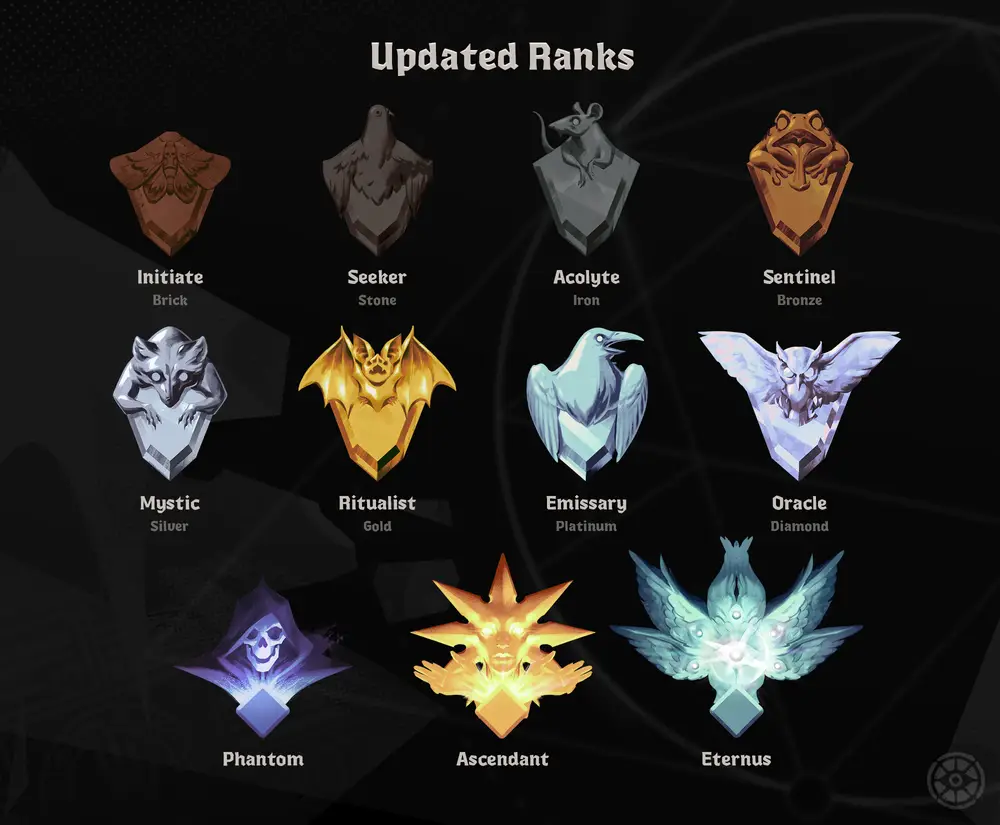
Points move about 250 per win or loss, with 1000 needed for a subrank promotion and 2000 for the last subrank before a new rank. Once you hit Eternus I the thresholds stop being fixed and get recalculated daily on a percentile basis. There is also loss protection: 5 games on a full rank boundary, 2 games on a subrank boundary, so one bad night does not drop your badge.
Solo or duo only, and the duo has to be your rank
Ranked accepts solo queue or a duo, nothing bigger. Both players in a duo must be at most one rank apart, and Eternus players can only queue with another Eternus inside three subranks.
We recognize that the party size and rank spread limits might be too restrictive, but we wanted to start off this way and then adjust in the future as needed.
– Valve, Matchmaking Update
If your usual group is a trio, ranked just split it. And finding one partner who is genuinely within a rank of you turns into asking around Discord servers and hoping the right person answers before you give up and solo queue.
The pre-game phase changes how matches start
Once a Ranked match forms you first see a breakdown of everyone's rank, then land in a pre-game waiting area where you can move your hero around. Hero picks happen in the queue, so this is where a bad composition gets fixed.
- Swap your hero once, into any hero nobody else took that you have unlocked for Ranked
- You only see the enemy team's starting composition, not what they swap into
- Set your starting lanes here, because zipline swaps are off afterwards
- Pause stays disabled for the first 2 minutes, so sort everything out before the match starts
Valve is explicit that this is a composition fix, not a counter-pick phase. Practically it means the first 30 seconds of a ranked game are now a conversation, and a duo that shows up with a plan gets more out of that window than five strangers typing over each other.
Abandons now cost more than the game
- Abandon before 5 minutes: the match is voided and safe to leave for everyone except the leaver and their party, who take the loss
- Abandon after 5 minutes: the leaver and their party take the loss, their teammates can leave safely or stay and still bank the win
- If the whole abandoning team leaves, the game ends immediately as a win for the other side
- Penalties start as queue timeouts and escalate into low priority games
The rules also cut both ways: if someone on the non-abandoning team then leaves too, that team falls under the same treatment, and nobody left on either side takes a loss.
What your first week actually looks like
The requirements mean the ranked pool starts small and fills up slowly, and Valve says the matchmaker gets more room to build balanced teams as that pool grows. Early queues will be looser than late-season ones, so treat the first calibration games as what they are: a rough seed, not a verdict.
The part you can control is who is on the other end of the duo slot. Teamplay lets you filter players by game, rank and region and post what you are looking for, instead of shouting into a Discord channel and hoping.
Ranked is solo or duo now
Your trio does not fit anymore, and the duo has to sit within one rank of you. Find that partner on Teamplay before your 8 calibration games start counting. It is free.